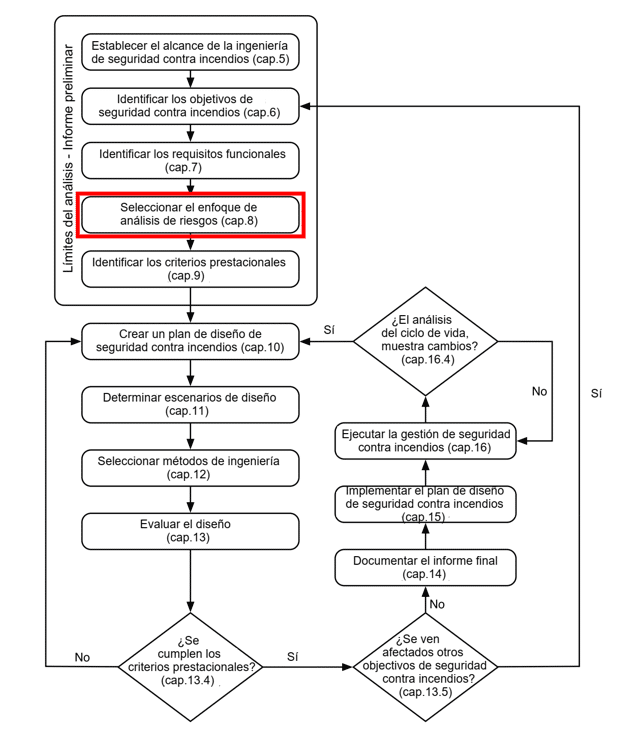
The ISO 23932-1 standard outline shows the different steps required for the development of a fire safety performance design process that meets the defined objectives.
After defining the project scope, the first step is to define the safety objectives, the functional requirements derived from those objectives, and the performance criteria that must be met to achieve each functional requirement.
Chapter 8 of the 2018 version expresses the need to choose the risk analysis approach. If quantitative, it will be either deterministic (the most common) or probabilistic (for highly specialized applications).
Deterministic Analysis in Performance Design
Deterministic analysis seeks to demonstrate that the initial reasonable worst-case scenario assumptions produce a result that fails a predetermined set of conditions. It is based on non-probabilistic inputs and variables and gives the same answer for any data set. But inevitably, fire is a stochastic phenomenon, and there are also uncertainties in the models.
Therefore, it is often necessary to ensure adequate safety margins or factors with respect to the acceptance criteria. Furthermore, we cannot avoid a probability study in deterministic analysis, even on a small scale. If not, how can it be demonstrated that this is a reasonable and credible worst-case scenario?
Probabilistic Analysis
In probabilistic analysis, the probabilities of a fire occurring are estimated, as well as the probabilities of success of the fire protection systems (active and passive). The consequences of the entire range of scenarios are estimated, along with their probabilities, to assess the risk (usually risk = probability x consequence) and compare it with a tolerable value. It requires statistical data on the frequency of such events or analytical tools (fault trees, event trees, etc.).
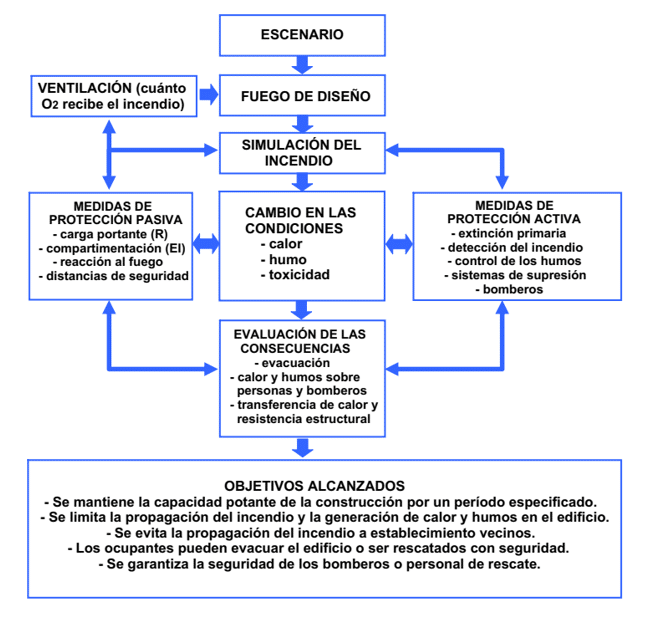
Once the scope of the performance study has been defined by preparing a preliminary qualitative report, the second stage of the process begins, which consists of defining the fire safety design and subjecting it to safety testing with different fire scenarios.
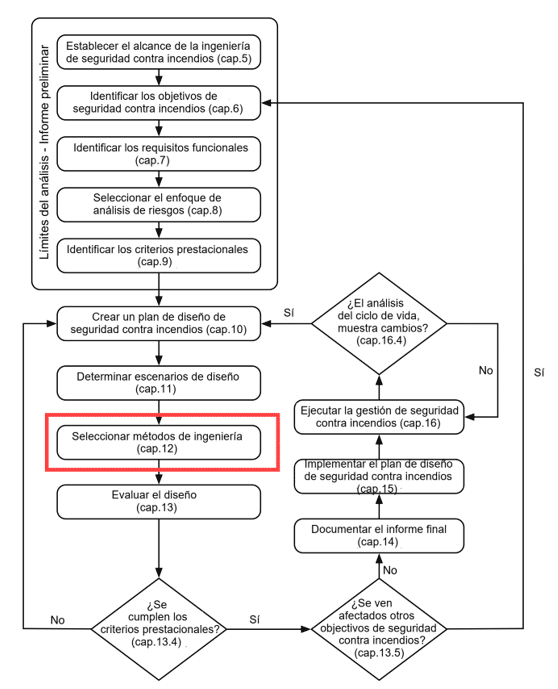
Chapter 11 for determining fire scenarios is extensive and developed independently in the ISO 16733-1 standard. Once the scenarios have been chosen, tests are conducted to confirm whether the adopted solution meets the performance criteria established in the first part. To do this, it is necessary to select which engineering methods will be applied.
These safety tests for each scenario involve simulating the fire and observing the heat, smoke, and toxicity conditions it produces, interacting with the passive and active protection measures that counteract that fire.
If the consequences for people, firefighters, and structures meet the pre-established performance criteria, then the process can proceed. If not, then it is possible to modify the passive and/or active protection measures, or even go further, modifying the safety objectives (if they have been too ambitious), modifying the performance criteria (if they have been too conservative), or modifying the fire scenarios (if they have been excessive based on their low probability of occurrence).
Fire Models in Performance Design
Engineering methods include the models that are intended to be used. A model is a conceptual scale representation, using physical and/or mathematical tools, of a complicated real-life process or system (phenomenon), intended to describe it, analyze its nature, develop or test hypotheses or assumptions, and allow for a better understanding of the real phenomenon it represents.
There is no perfect tool; models are a partial representation of reality and a simplification of very complex phenomena.
The most important attribute of Fire Models must be their ability to rigorously and realistically predict fire behavior within pre-established limits.