The RIPCI is explicit on this point: every fire protection system has a maximum interval between two consecutive maintenance visits, set out in Annex II of the regulation.
Quarterly, six-monthly, annual and five-yearly. Four different cycles, each with its own operations and a different depth of work.
This article sets out those schedules equipment by equipment, explains what the maintenance logbook must contain and who is authorised to certify each check.
What the RIPCI requires for fire protection maintenance
Royal Decree 513/2017 requires active fire protection equipment and systems to undergo the maintenance checks in its Annex II. Article 21 is explicit: it sets, in each case, the maximum time that may pass between two maintenance visits.
Missing the schedule is not a minor formal breach: it leaves an active fire protection system with no guarantee of response on the day it is needed.
The records of each maintenance visit, signed by the qualified staff who carried it out, must be available to the regional industry authority for at least five years from their date of issue.
Annex II schedules, equipment by equipment
The regulation sets out four cycles, split across two tables. As a general rule, every system is checked at every interval: what changes are the operations carried out on each element and who may perform them.
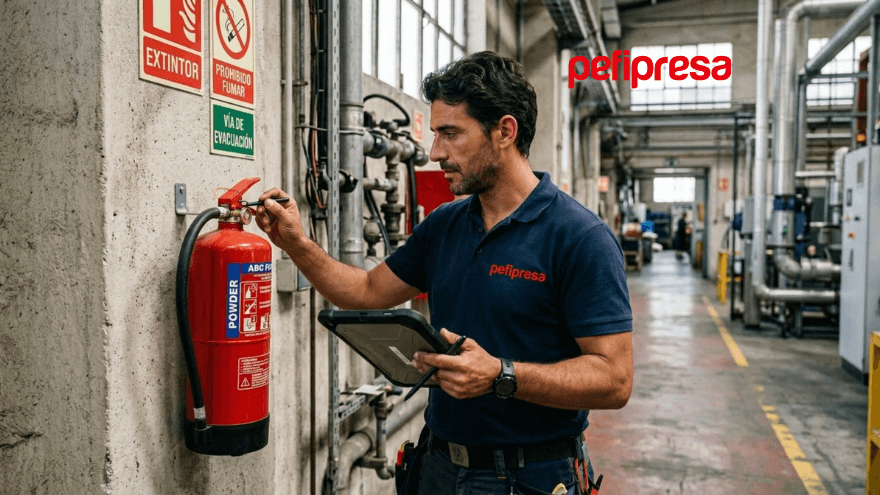
- Quarterly (Table I) — the owner’s staff or a maintenance company: generally, a visual inspection of fire extinguishers, hose reels, signage and equipment accessibility, with parameter and pressure readings.
- Six-monthly (Table I) — the owner’s staff or a maintenance company: greasing and verification of the various checkpoints of each system.
- Annual (Table II) — authorised maintenance company: functional tests of the installation.
- Five-yearly (Table II) — authorised maintenance company: in general, pressure tests of the various extinguishing elements, such as the periodic pressure retest of extinguishers under the Spanish Pressure Equipment Regulation or the five-yearly hose inspection of hose reels under UNE-EN 671-3.
Every check must produce maintenance records and a certificate, regardless of the interval and of who carries it out.
On top of this comes, every ten years, the inspection by an accredited control body in the installations that require it, under Article 22 of the RIPCI.

The operations also vary by system: automatic sprinklers, dry risers, hydrants, water mist, gas extinguishing and smoke and heat control (SCTEH) have specific operations within the Annex II tables, in addition to the weekly checks that some UNE product standards require in the pump room.
The fire protection maintenance logbook: what it must contain
Every operation — quarterly, six-monthly, annual or five-yearly — generates a record. Together, those records make up the owner’s logbook, which must identify without ambiguity what was checked and with what result.
These minimums apply even when the operation does not require full compliance with the UNE 23580 standard for maintenance records, as is the case with quarterly and six-monthly checks carried out by the owner. Every record must be signed by whoever performs the maintenance and by the property’s representative.
When issues are found, the proposed actions are documented alongside the result or in the technical report that Article 17 of the RIPCI requires to be delivered to the owner.
Who can carry out each operation: owner or authorised maintenance company
The RIPCI recognises two roles. The owner may personally carry out the quarterly and six-monthly operations in Table I, given their simplicity, or even acquire the status of maintainer of their own equipment if they have sufficient technical and human resources and civil liability insurance.
Outside that case, every annual or five-yearly operation requires, as a general rule, an authorised maintenance company, with a responsible declaration filed with the relevant regional authority.
The maintenance company may also take on every check in the programme, including those in Table I.
Our track record as a fire protection installer and maintainer covers the regulation’s schedules for any of the systems included in Royal Decree 513/2017.
Certification of the maintenance company and its technical staff
Being registered is not enough. Article 15 of the RIPCI requires the maintenance company to hold a quality certificate for its management system, issued by an accredited body, whose scope explicitly covers each piece of equipment it maintains.

For extinguishers, the certifying body must also verify compliance with the UNE 23120:2011 standard. For fluorinated gaseous agent systems, staff need the specific qualification under Royal Decree 115/2017. Both requirements come on top of the minimum professional civil liability policy of 800,000 euros required by the regulation.
What happens if the maintenance schedule is not met
Failure to comply with Annex II is classed as an infringement under the penalty regime of Spanish Industry Act 21/1992, with fines that scale according to the seriousness of the infringement. The sector’s technical committee points out that the quarterly extinguisher check under the RIPCI is simple, but it conditions everything else.
How Pefipresa manages it: traceable fire protection maintenance
PEFIPRESA plans the RIPCI schedules within a single preventive and corrective fire protection maintenance contract, with issue of records, filing of the logbook and advance notice of each check date.
Every operation is traced, signed and available for audits by insurers, loss adjusters or the authorities themselves, without depending on a physical folder that can go missing.
If you want to review your installation’s maintenance schedule, contact our fire protection engineering team and request a technical audit of your fire protection system.
Frequently Asked Questions about RIPCI maintenance schedules
What must the fire protection maintenance logbook contain?
The logbook brings together, equipment by equipment, the product type and model, its unique identification and the operations carried out with their result. If there are issues, the proposed actions are documented alongside the result or in the technical report that the maintenance company delivers to the owner. These minimums apply even when the check does not require full compliance with UNE 23580, and every record must be signed by whoever performs the maintenance and by the owner’s representative.
Who can carry out the quarterly check of fire protection equipment: the owner or the maintenance company?
The RIPCI allows the quarterly and six-monthly checks, listed in Table I of Annex II, to be carried out by the owner or by staff designated by the owner, without hiring a maintenance company, because they are the simplest operations in the programme. The annual and five-yearly checks in Table II require staff from an authorised maintenance company, which may also take on those in Table I.
What certification do the staff carrying out annual fire protection maintenance need?
The maintenance company must hold a quality certificate for its management system, issued by an accredited body, whose scope explicitly covers each piece of equipment or system it maintains. For extinguishers, the certifying body must also verify compliance with UNE 23120; for fluorinated gaseous agents, staff need the specific qualification under Royal Decree 115/2017.
What penalties does the RIPCI provide for if the maintenance schedule is not met?
Failure to comply with the Annex II schedule is classed as an infringement under the penalty regime of the Spanish Industry Act, with fines that scale according to seriousness. Beyond the financial penalty, a system without documented maintenance can void insurance cover and compromise the outcome of an industry inspection.
How long must fire protection maintenance records be kept?
The RIPCI requires maintenance records to be kept for at least five years from their date of issue, available to the regional industry authority. The maintenance company also keeps, for the same minimum period, the documentation of the repairs and operations it carries out.