
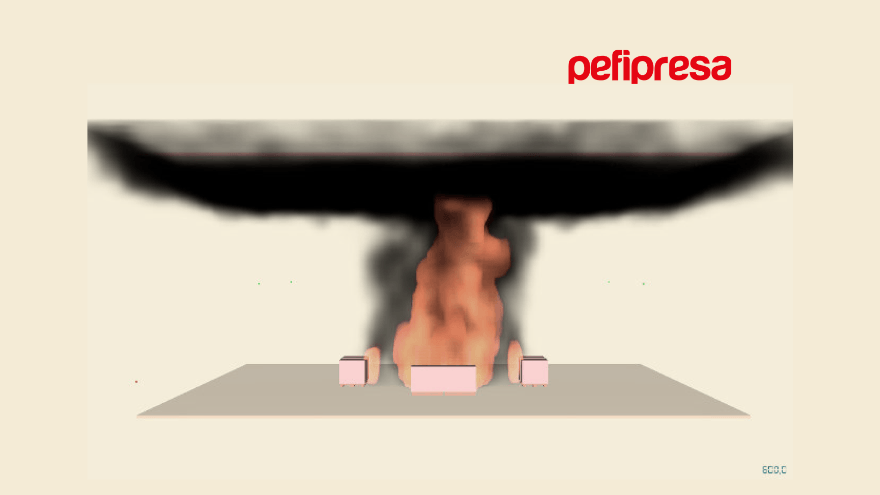
In industrial fire protection, one of the most complex aspects is the interaction between fire and automatic sprinklers when simulating water discharge in CFD programs such as the Fire Dynamics Simulator (FDS) by NIST.
This article, a continuation of the previous studies (Parts 1 and 2), analyses an FM fire test with plastic pallets stacked on the floor and demonstrates how the «extinction coefficient» methodology (E_COEFFICIENT) makes it possible to reproduce the real fire behaviour in storage scenarios with great fidelity.
1. The challenge of validation in FDS
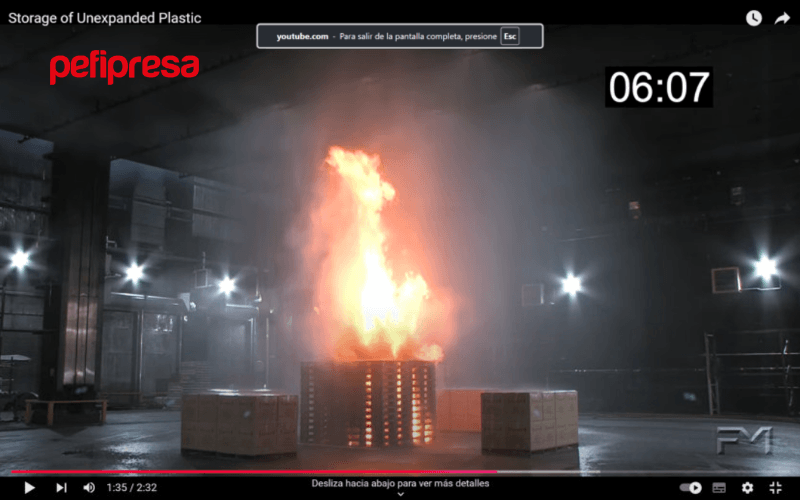
- Objective: to compare the results of FDS (with water discharged and a well-adjusted extinction coefficient) against a real FM fire test in which plastic pallets were burned under a ceiling 9 m high, with K160 sprinklers at 74 °C and only 0.5 bar of pressure.
- Real test: due to the low discharge density (approximately 12.5 mm/min), the sprinklers did not control the fire, which ended up activating all the heads. However, it did not spread to other merchandise thanks to the 2.4 m aisles.
2. The extinction coefficient method
- E_COEFFICIENT: based on the experimental results of Yu, Lee and Kung, it relates the water density (in kg/(m²·s)) to the decay rate of the fire.
- 3D surfaces: it is essential to use the «surface» extinction coefficient to account for the cooling/penetration of water into the real geometry of the stacked load, as recommended in Parts 1 and 2.
- Heat release rate per unit area: for «unexpanded unprotected plastics» (UUP), a value close to 500 kW/m² is confirmed, which justifies the high fire intensity.
Expert advice: in our experience designing sprinkler systems for plastic goods warehouses, calibrating the E_COEFFICIENT to match the actual fuel category — rather than using a generic value — makes the difference between a reliable simulation and one that severely underestimates fire power. We have verified that the experimental values of Yu, Lee and Kung, combined with 3D surfaces, reproduce laboratory fire tests with great accuracy.
3. Scenario and simulation results
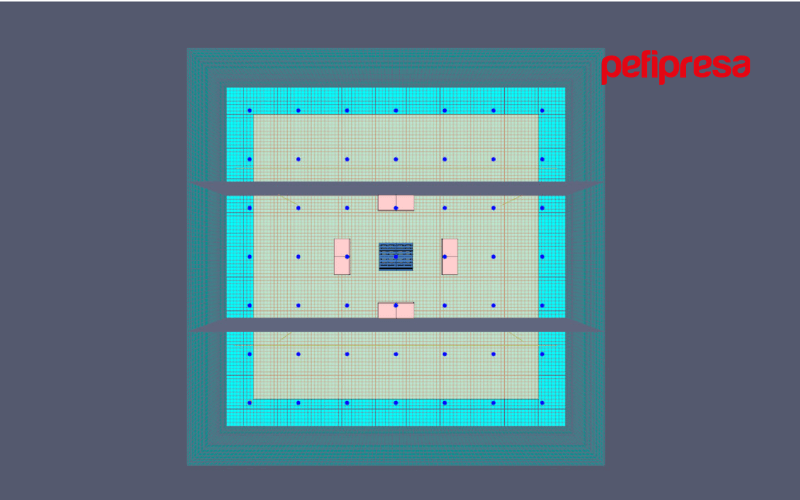
The conditions reproduced in FDS faithfully reflect the original FM test scenario:
- Ceiling without lateral enclosure: the absence of walls is modelled, just as in the test, to avoid overestimating smoke accumulation.
- K160 sprinklers at 0.5 bar: each sprinkler discharges 113 l/min, equivalent to 12.5 mm/min distributed over 9 m² per sprinkler.
- 0.25 m cells in the simulation mesh.
Main conclusion: the fire was not controlled at that density of 12.5 mm/min — the same result as in the test — reaching peak outputs of up to 25–35 MW and activating all the sprinklers.
Comparison with standards
The appropriate discharge density for plastic storage scenarios is established in the main international standards:
- NFPA 13 and EN 12845 (Annex G.5) recommend for exposed plastic pallets at the storage height of this test: ≥24–25 mm/min and operation areas between 185–300 m².
- FM 8-9 demands up to 33.3 mm/min (much higher flow rate) but covers greater storage heights than those in the test.
The FDS simulation at those higher densities does achieve suppression, activating a number of sprinklers within the design area. This is consistent with sprinkler design tables and confirms the validity of the simulation method.
Key data: at the test discharge density (12.5 mm/min), the system does not control the fire. At the density required by standards such as FM 8-9, NFPA 13 or EN 12845, the fire is suppressed. The difference between a correct prescriptive design and a deficient one can mean the mass activation of the entire sprinkler system.
4. Key highlights
- Correspondence with a real fire: at the same discharge density as in the test, the FDS result matches: the entire system activates and the fire is not controlled.
- Normative densities: standards such as NFPA 13, FM 8-9 or EN 12845 (G.5) set higher flow rates. Simulations with those values predict suppression or control.
- Relevance of the E_COEFFICIENT: the Yu, Lee and Kung methodology proves robust once again. By adjusting its value according to the water density and fuel category (plastic vs. cellulosic), FDS faithfully reproduces fire evolution.
- Monitoring active sprinkler count: at higher heat release rates (e.g., 500 kW/m² vs. 400 kW/m²), more heads activate, reflecting that considering only the «first sprinkler» is insufficient to determine the fire peak.
5. Final conclusions
- Successful validation: the extinction coefficient applied to CFD modelling correlates excellently with real fire tests and with the prescriptive requirements for water densities across different storage risk categories.
- Importance in storage scenarios: some simplified designs (which assume fire control with the first sprinkler) may underestimate the fire’s final power. This case demonstrates that fires involving exposed plastics can reach very high outputs and trigger a mass activation of sprinklers.
- Practical application: to correctly size a sprinkler system — or to validate performance-based projects — it is crucial to identify the actual material category, its heat release rate and the minimum adequate discharge density.
In summary, this study confirms the validity of the performance-based method founded on the extinction coefficient and underlines the need to use design densities consistent with standards in order to effectively control fires involving plastic goods. Those wishing to delve deeper into the simulation details and applied equations may consult the full document and the cited references.
Main references
- Validation of the extinction coefficient when modelling fire with automatic sprinklers – Part 1, 2024
- Validation of the extinction coefficient when modelling fire with automatic sprinklers – Part 2, 2024
- EN 12845:2021, «Automatic sprinkler systems»
- NFPA 13:2022, «Standard for the Installation of Sprinkler Systems»
- FM 8-9:2022, «Storage of Class 1, 2, 3, 4 and Plastic Commodities»
Frequently Asked Questions
What is the extinction coefficient (E_COEFFICIENT) in FDS simulations with sprinklers?
The E_COEFFICIENT is a parameter of the Fire Dynamics Simulator (FDS) program that models the suppression of fire by water. Based on the experimental work of Yu, Lee and Kung, it relates the applied water density (in kg/(m²·s)) to the decay rate of the fire’s heat release rate. Its correct calibration according to the fuel type is essential for obtaining realistic simulations.
How is a CFD fire simulation validated against a real fire test?
Validation consists of reproducing in FDS the same conditions as the real test: fuel type, storage geometry, sprinkler characteristics (K-factor, activation temperature, pressure) and discharge density. If the simulation results (maximum power reached, number of sprinklers activated, whether or not the fire was controlled) match the real test, the methodology and parameters used are considered validated.
What discharge density does NFPA 13 require for plastic pallet storage?
For exposed plastic pallets at storage heights similar to those in the analysed test (up to 2 m stacking height, ceiling at 9 m), NFPA 13 and EN 12845 (Annex G.5) recommend discharge densities of at least 24–25 mm/min, with operation areas between 185 and 300 m². FM 8-9 may require up to 33.3 mm/min for greater storage heights.
Why can a sprinkler system with a low discharge density fail against a plastic fire?
Unexpanded unprotected plastics (UUP) have a heat release rate per unit area of approximately 500 kW/m², far higher than cellulosic materials. At low densities (such as the 12.5 mm/min in the test), the water discharged is insufficient to cool the load and reduce the heat release rate, so the fire continues to grow and activates all sprinklers without achieving control.
When is an FDS simulation with sprinklers considered valid for performance-based design?
An FDS simulation is valid for performance-based design of sprinkler systems when it faithfully reproduces the results of reference fire tests: the same system activation outcome, consistent heat release rates and a number of activated sprinklers within the normative design area. When the simulation at the normative density (e.g. 24–25 mm/min for plastics) achieves suppression and the one at lower density does not, the model is confirmed to be correctly calibrated and may be used to validate projects.