Introduction
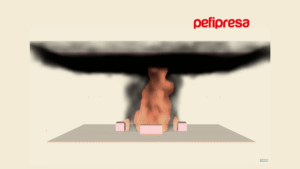
Fire simulations in environments with automatic sprinklers often simplify the fire development curve by assuming that, after the first sprinkler activates, the heat release rate either “stabilizes” or decreases drastically. However, experience and technical literature on fire protection show that in many real scenarios, the fire can continue to grow and consequently activate more sprinklers, generating larger volumes of smoke and affecting visibility or toxicity.
This article summarizes the reflections presented in a more extensive study, whose fundamental objective is to raise awareness among fire safety professionals and those responsible for designing smoke control systems about the importance of adequately representing the fire curve in the presence of sprinklers.
The challenge of defining the fire curve
When modeling a fire with engineering methods (for example, with FDS), multiple parameters are defined: fuel type, calorific value, maximum specific power, radiated fraction, among others. But there is one particularly influential piece of data in the simulation behavior: the shape of the fire development curve (Heat Release Rate or HRR as a function of time).
In installations without sprinklers, empirical or standardized curves (such as slow, medium, fast or ultra-fast growth curves) are used to represent the growth phase of heat release rate over time, and growth stops due to limitation in the amount of fuel present or ventilation and is reduced by fuel depletion.
Different approaches for sprinklered installations:
- Criteria that “stop” the curve at a fixed heat release rate value (for example, upon activation of a number of sprinklers).
- Criteria that allow the fire to decrease abruptly after activation of the first sprinkler.
- Modeling that explicitly includes the water effect, simulating the discharge pattern characteristics, with or without introducing an extinction coefficient that reduces the combustion rate at the fire source.
Each method involves assumptions that can distort reality if not applied rigorously. In particular, ignoring or underestimating the possibility of a fire exceeding certain megawatts (and thereby activating the design operation area in sprinklers) can lead to erroneous conclusions about visibility or evacuation conditions. To delve deeper into these technical aspects, we recommend also consulting our article on the new RSCIEI.
Why is it critical to consider the maximum credible fire power?
1. More power = more combustion products
Although the temperature of the smoke layer may be limited due to the activation of several sprinklers, the mass of fuel consumed continues to increase proportionally with the fuel that burns. This implies greater smoke production, more obscuration and increased toxicity for higher powers.
2. Greater number of activated sprinklers
A single sprinkler does not usually provide the water density necessary to control fires of a certain magnitude. Therefore, if the fire grows to the point of involving several sprinklers (many designs contemplate an operation area with dozens of them), more unfavorable smoke conditions are generated for evacuation and damage control.
3. Worst reasonable scenario
In a performance analysis, the “worst” scenario must be credible and within the design hypotheses. If the system is calculated for a determined operation area, nothing prevents all that set of sprinklers from being activated in a real fire. Therefore, if this case is not modeled in the simulation, we may underestimate the final smoke conditions.
Reference methods and their limitations
There are several guides and regulations that propose different approaches to “cut” or “stabilize” the fire curve when sprinklers come into action. For example:
Main methodologies:
- Lund (Sweden, Denmark, Norway): After activation of the first sprinkler, if the initial power is less than 5 MW, the curve is allowed to be reduced to 1/3 of that value after one minute. For fires greater than 5 MW, the curve remains constant.
- ISO 16733-1: Power is assumed constant upon activation “of the sprinkler system.” The nuance lies in when the system is considered “active”: at the first sprinkler or when effective discharge density is achieved?
- NFPA 204: Recommends basing the criterion on activation of a “conservative number of sprinklers,” normally considering sprinklers within a radius 1.5 times the distance between them and the fire source.
- UNE EN 12845: Designs the sprinkler system based on density and an operation area expressed as the number of activated sprinklers.
The main limitation of criteria based solely on activation of one or few sprinklers is that they ignore the cumulative effect of several open sprinklers and the possible evolution of the fire to the maximum design capacity of the system. Without including water discharge in the simulation (and the consequent real cooling of gases), activation times of successive sprinklers after the first become fictitious, underestimating the final fire power.
Simulation examples and practical conclusions
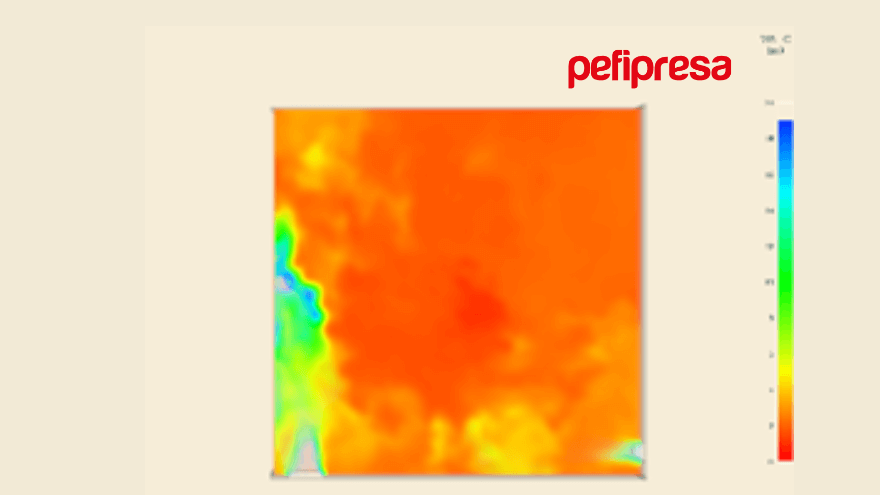
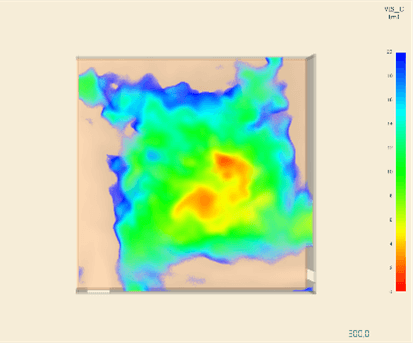
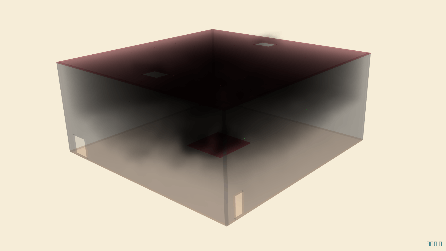
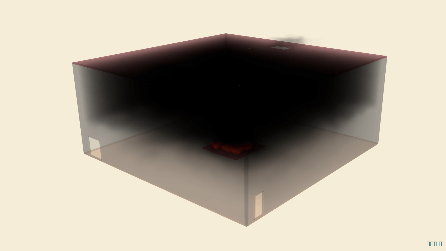
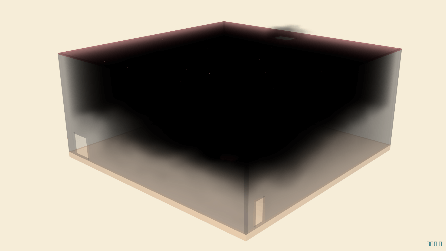
Various simulations performed on the same storage scenario (FM Global reference at 9 m height, with K160 sprinklers, 3×3 m spacing between sprinklers) show notable differences:
In such cases, a large amount of smoke is produced, worsening visibility and increasing evacuation risk. In this example, the low fire of UNE 23585 corresponds to 5 MW and is equivalent to the NFPA 204 criterion stopping the curve with the 4th sprinkler. The high fire of UNE 23585 is 12 MW activating more sprinklers than the design area of UNE EN 12845.
International experience suggests that, in most sprinkler-controlled fires, few heads are activated. However, when performing a performance evaluation, the aim is to guarantee safety against a limit but realistic scenario. Even though it is unlikely that the entire sprinkler design area will be activated, it is not impossible for this to happen under certain conditions of load, combustibility, source location, obstructions, interstices, etc.
NO WATER DISCHARGE (Visibility at 2 m height and 300 seconds)
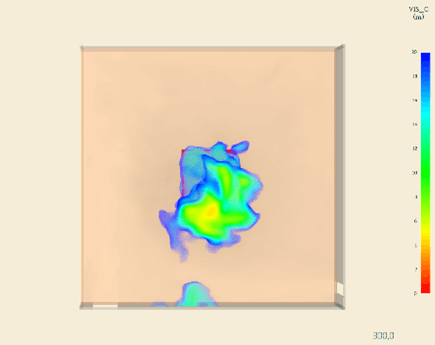

3D view of the fumes
WITH WATER DISCHARGE (Visibility at 2 m height and 300 seconds)
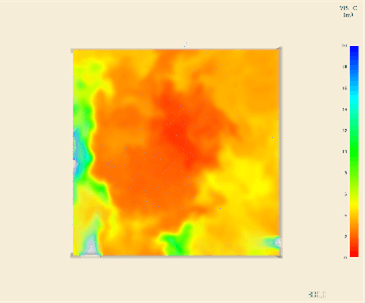
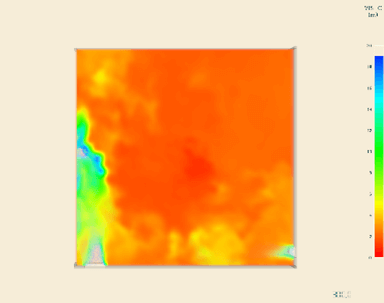
3D view of the fumes


Final recommendations
1. Evaluate both extremes: a scenario with incipient activation of few sprinklers (representing most fires) or even where the fire decreases due to sprinkler activation, and another where the fire reaches the maximum credible power that activates the system’s design area.
2. Include water discharge in the simulation: if deciding to stop the HRR curve upon activation of a number of sprinklers, it is essential to model the cooling and entrainment effect of previous sprinklers.
3. Verify impact on visibility and toxicity levels: a higher power fire can generate denser smoke, even if its temperature is limited by sprinkler action.
4. Apply equivalence to UNE EN 12845: it is coherent to equate fire power so that the density and operation area of sprinklers according to the design standard is reached.
5. Strengthen model validity: using discharge patterns and “super-droplets” in FDS or other programs allows approximating the real effect of sprinklers. Although it increases computational resources, it is key to obtaining more reliable conclusions.
Conclusion
Smoke control performance studies in buildings with automatic sprinklers often remain in a conservative “but not sufficient” scenario: the one that assumes fire stabilizes at the first or second sprinkler. This approach, while valid in many real fires, does not guarantee covering that minority fraction of cases where fire grows enough to activate multiple sprinklers progressively.
The selection of the appropriate fire curve and inclusion of the real effect of water discharge are key to a truly robust SCTEH design. It is a message that specialists in fire protection engineering and project managers should consider to avoid under-dimensioning safety measures in their facilities.
Summary bibliography
- NFPA 204 “Standard for Smoke and Heat Venting”, 2021.
- SFPE Handbook of Fire Protection Engineering (5th Ed.), 2016.
- UNE 23585:2017. “Requirements and calculation and design methods for designing an SCTEH in case of stationary fire”.
- UNE EN 12845, “Automatic sprinkler systems”, 2021.
- Nystedt, F. “Verifying Fire Safety Design in Sprinklered Buildings”, Lund University, 2011.