
Simulations are experimentation with a model, a hypothesis or a set of working hypotheses. In computer simulations, dynamics predominate over static ones, since it is usually necessary to experiment with situations that change over time.
It is essential to exercise caution since the results of the simulations are as good as the input data, the underlying assumptions and the respect for the limitations of the model.
Usefulness of fire simulations
The usefulness of simulations lies in the fact that they serve two main purposes:
As an analysis tool
To predict the consequences of a fire in a specific existing scenario. Also to evaluate the causes, evolution, actions or consequences of a fire that occurred in a real scenario. This predictive capability is essential in fire protection engineering.

As a design tool
To study the effectiveness of a selected group of measures aimed at preventing a fire or minimizing its consequences in a projected scenario. This approach allows for the optimization of fire detection and extinguishing systems before their implementation.
Model validation and verification
Every model used for computer simulation (fire, evacuation, structural strength) must be validated and verified for the type of scenario envisaged. Although the two terms are closely related, there is a subtle difference between them:
Validation is the process of determining the degree to which a calculation method is an accurate representation of the real world from the perspective of the calculation method’s intended uses. Validation is a check of the physics.
Verification is the process of determining that the implementation of a calculation method accurately represents the calculation method developer’s conceptual description and the calculation method’s solution. Verification is a check of the mathematics.

Types of Fire Simulation Models
Among the fire models currently available, we can distinguish several types based on their complexity and application:
Analytical Calculations
Analytical calculations by hand or using a spreadsheet, which are based on physically and mathematically simplified models, allowing for rapid calculations without the need for a powerful computer. They are useful for initial approximations and indicative checks of the results of more complex models.
These models can estimate:
- Time to ignition
- Fire curve
- Flame length
- Air entrainment and smoke generation by the plume
- Plume temperature
- Flame spread
- Smoke layer height
- Activation of detectors and automatic sprinklers
- Flashover
- Post-flashover conditions
Specialized computer programs
Equation-based computer programs Analytical or finite element models. Within this category, there are two main subcategories:
Zone models
Zone models divide the space into zones (one or two per compartment) to solve the equations. They are the simplest, with good representation in their application domain, easy and quick to use, and are useful for performing parametric, sensitivity, and risk analysis studies.


Field Models
Field models allow for complex geometries, uneven fuel distribution, assess the magnitudes of the thermal and fluid dynamics of the fire in space and time, and provide more variables (visibility, temperature, species concentration, flow rates, etc.). Their disadvantage is the high computational cost and the need for greater model definition.
A field model is the most comprehensive and sophisticated model as it subdivides the space into multiple cells in which the properties are considered uniform and interact with their neighbors.

Advanced Features of Field Models
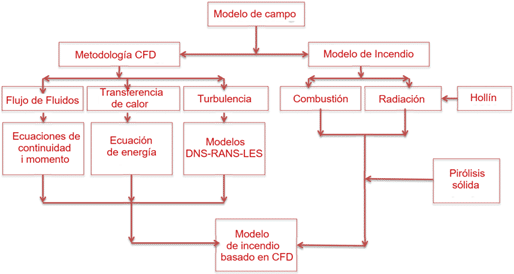
Field models use an aerodynamic basis to evaluate fluid flow, heat transfer, and turbulence phenomena, similar to those applied in aircraft or vehicle design, to which are added the phenomena of combustion, radiation, and product generation.
These models determine the following in the different cell volumes:
In gaseous zones: characteristics of temperature, velocity, species concentration, pressure, liquid fraction, etc.
On solid surfaces: surface temperature, interior temperature, heat flux, combustion rate, mass of water droplets per unit area, among others.
Some parameters are global, such as heating power, sprinkler and detector activation time, or mass and energy fluxes through openings and solids. This detailed analysis capability makes them indispensable tools for performance-based design.
Conclusion
Fire simulations represent a fundamental tool in modern performance design, enabling both predictive analysis and the optimized design of fire protection systems. The choice of the appropriate model will depend on the complexity of the scenario, the available resources, and the required accuracy of the results.