
Introduction
In performance-based fire simulations in warehouses, the “ultra-fast” curve is often assumed to represent the evolution of heat release rate over time. However, this standard model can drastically underestimate the actual growth rate in storage environments, especially when products are stacked at height or when dealing with highly combustible goods (plastics, foams, etc.).
This article highlights the importance of refining the fire curve by considering storage height, commodity type, and empirical evidence from standards such as NFPA 204 or full-scale tests. The objective is to ensure that fire simulations faithfully reflect the magnitude and speed of the potential fire, which is critical for properly sizing fire protection systems (sprinklers, smoke and heat exhaust systems, available safe egress time, structural resistance, etc.).
The risk of relying solely on the ultra-fast curve
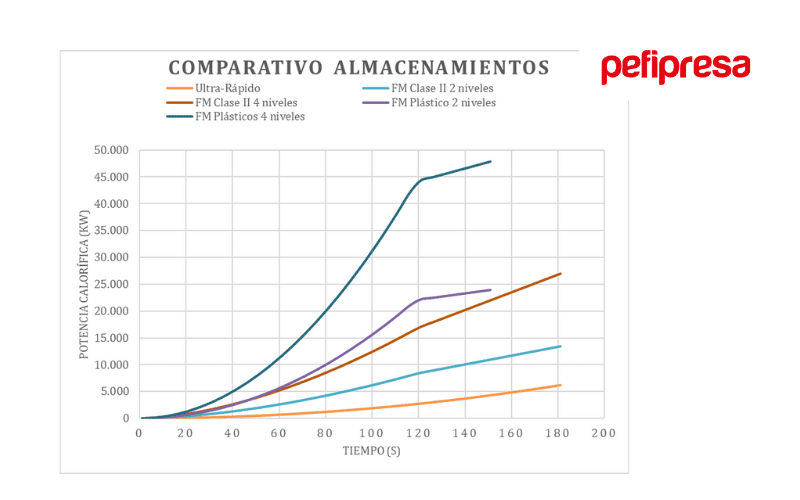
Ultra-fast: 75 s to reach 1 MW, with a growth coefficient α = 0.188 kW/s².
However, for warehouses with combustible products stacked at various heights, the literature (NFPA 204, SFPE Handbook, FM tests) shows that the fire can develop much faster than the traditional “ultra-fast” curve, due to:
- Vertical accumulation of goods.
- Highly combustible nature of certain plastics, foams, etc.
- Additive effect of multiple levels or pallets that ignite almost simultaneously.
Thus, it is common to find fires with times of 7 to 10 s to reach 1 MW, equivalent to growth coefficients that double or even exceed by several dozen times the α value of 0.188 kW/s².
The perspective of NFPA 204 and SFPE
NFPA 204
In its Annex F, it presents growth time values for various materials and heights, some below 75 s (for example, plastics stored at 4.57 m).
It explains that α is proportional to storage height, so that doubling the height can double the fire growth rate.
SFPE Handbook
In its Chapter 26 (“Heat Release Rates“), graphs and tables derived from FM tests are presented, where heat release rate multiplies by very high factors as the number of rack levels increases.
Figures such as 26.49 illustrate that growth curves become increasingly steeper as product height increases.
FM Tests (Zalosh)
According to “Industrial Fire Protection Engineering” (Zalosh), tests reveal that the heat release rate (α) grows significantly with just 2 or 3 pallet heights.
The final curves can be far superior to the “ultra-fast” standard, exceeding 30-40 MW in a few minutes for certain plastics.
Practical examples
Class II (cardboard boxes) at 4 heights
While the “ultra-fast” curve indicates about 2.7 MW at 120 s, FM tests point to up to 17 MW for that same class of material when stacked at 4 levels.
Plastics at 4 heights
The fire can easily exceed 45 MW in 2 minutes, compared to 2.7 MW from the standard curve.
The differences skyrocket the greater the quantity of product and its ease of ignition.
FDS simulation with stacked pallets
An isolated pallet reaches 3.5 MW in a certain period; but if several pallets are successively ignited in the same space up to 5 heights, the combined power can exceed 65 MW in the same time interval.
These examples make it clear that a single “unit” curve does not correctly represent the global fire in a warehouse. The progressive ignition of adjacent pallets or upper levels must be considered, each with its own curve, which considerably accelerates total growth.
Conclusions
It is essential to:
- Consider storage height and product nature (Class II, plastics, etc.).
- Review empirical references (NFPA 204, SFPE) indicating much higher growth rates.
- Apply multiple curves and cumulative calculations when several load units ignite simultaneously.
- Validate behavior with CFD tools, assigning realistic ignition temperatures and accounting for incident radiation between pallets.
Only in this way will more realistic estimates of fire development be obtained and, consequently, a fire protection design (sprinklers, ventilation, available safe egress time, structural resistance) adjusted to the magnitude of the risk.
References
- ISO 16733-1:2017, Fire safety engineering — Selection of design fire scenarios and design fires.
- NFPA 204:2021, Standard for Smoke and Heat Venting.
- SFPE Handbook of Fire Protection Engineering, 5th Ed., 2016.
- Zalosh, R. “Industrial Fire Protection Engineering”, Wiley, 2002.
About Pefipresa
Pefipresa, a company with over 60 years of experience in the fire protection sector, offers comprehensive solutions for the design, installation, and maintenance of fire safety systems in all types of industrial and commercial facilities. Our team of specialized engineers uses the most advanced simulation and modeling tools to ensure maximum protection tailored to each specific project.
For more information about our fire protection engineering services and performance-based simulations, please do not hesitate to contact us.