Introduction
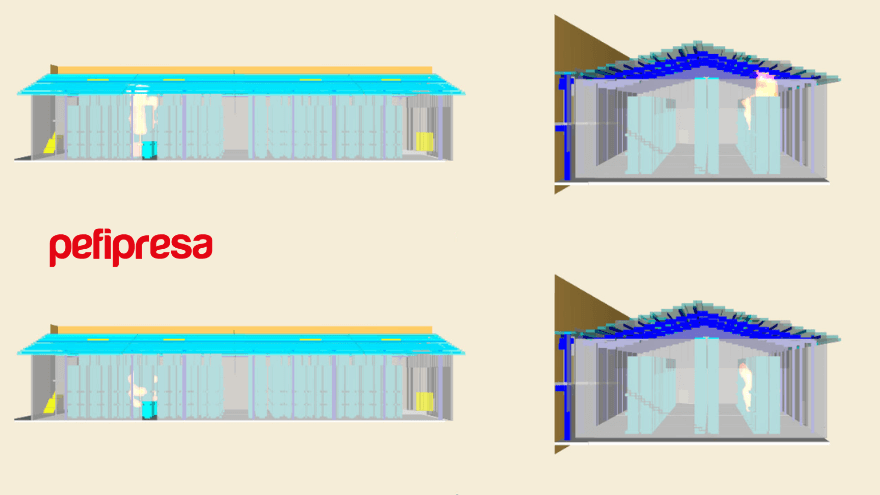
Fire simulation with automatic sprinklers using CFD programs (e.g., FDS) allows for more realistic prediction of flame behavior, smoke, and the effect of discharged water. However, one of the main challenges is to adequately represent the extinguishing capacity of sprinklers, as it is not enough to limit oneself to their “cooling effect”.
This article synthesizes an exhaustive study validating the use of an “extinction coefficient” (E_COEFFICIENT) when modeling fires in enclosures with ceiling heights up to 12 m and storage up to 7.2 m. The results of various simulations are compared with sprinkler design criteria contemplated in UNE EN 12845, NFPA 13, and FM guidelines, demonstrating the consistency between both approaches when extinction is included in the modeling.
Fundamentals of simulation and the extinction coefficient
Fire development curve
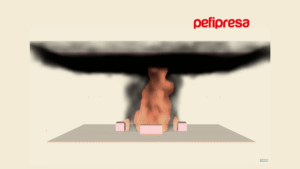
In the study, the fire is represented not as a pre-set curve, but by allowing each “cell” of combustible material represented in 3D to ignite upon reaching the ignition temperature. The result is a more realistic fire progression, both in growth and decay.
Water discharge
Sprinklers that activate at their trigger temperature (68 °C, 74 °C, etc.) are simulated, discharging a flow rate according to design density (e.g., 5 mm/min, 17.5 mm/min, 27.5 mm/min or more). FDS allows tracking “droplets” or “super-droplets” that absorb heat through evaporation, cooling the environment.
Extinction coefficient (E_COEFFICIENT)
Various experimental studies (Madrzykowski and Vettori [NIST], Evans, Yu-Lee-Kung) show that fire power decays exponentially when water impinges on the fuel. Including this coefficient in FDS (adjusted according to the discharged density) makes the simulation reproduce the actual control or suppression phenomenon.
Reference scenario and product categories
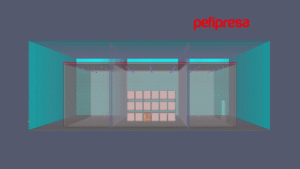
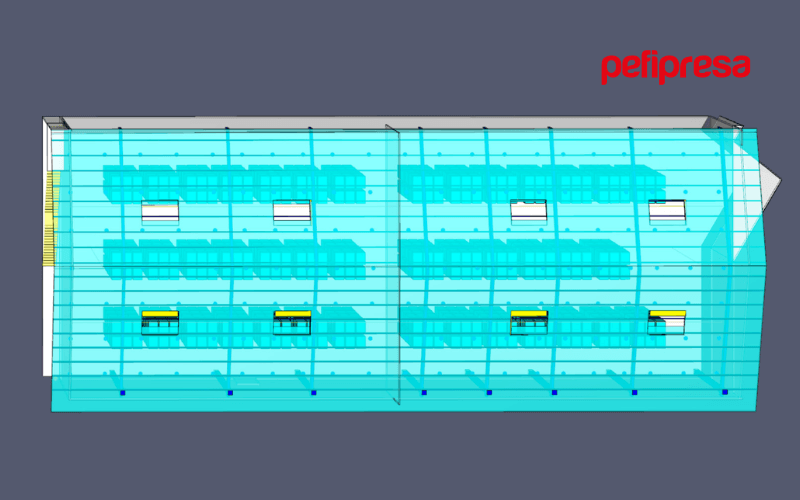
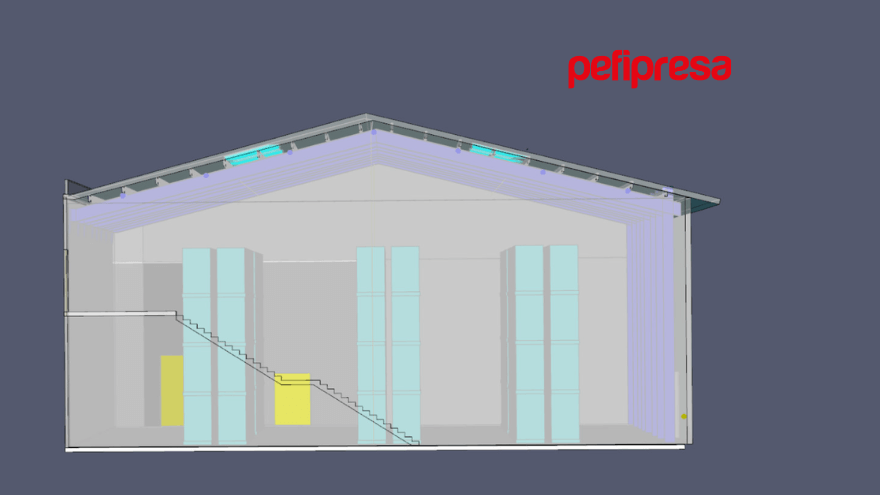
A warehouse with 7.2 m storage height (with ceiling at ~9-11.5 m) is considered, and different commodities are examined:
- Category II (cellulosics), maximum power of 250 kW/m²
- Category III (non-expanded plastics), between 400 and 500 kW/m²
- Category IV (expanded plastics), 625 kW/m² or more
Likewise, three sprinkler configurations are analyzed:
- Standard sprinklers designed for 17.5 mm/min (Category II)
- Standard sprinklers designed for 27.5 mm/min (Category III)
- ESFR sprinklers (Early Suppression Fast Response), with much higher flow rates (e.g., 456 l/min per sprinkler, equivalent to > 50 mm/min).
Key results
If the extinction coefficient is NOT included:
The fire is “cooled” but not fully controlled, reaching powers of 20-50 MW and activating an excessive number of sprinklers.
This does not agree with actual practice nor with the “operating areas” provided in the standard (e.g., 260 m², 300 m², etc.).
When the extinction coefficient IS included:
- The number of activated sprinklers matches what the design standard stipulates (example: ~28 sprinklers for Category II, ~36 sprinklers for Category III, etc.).
- In “control” mode, the curve stabilizes at a fixed level (7-8 MW for Category II, 15-18 MW for Category III).
- In “suppression” mode (ESFR sprinklers), the curve reaches a peak and then declines sharply, leaving small residual fires.
Categories and powers per unit area:
- 250 kW/m² fits cellulosic products well.
- 500 kW/m² represents exposed non-expanded plastics.
- >625 kW/m² requires densities and operating areas typical of Category IV or expanded plastics (greater coverage, higher flow rates, etc.).
Number of droplets (particle size):
It is observed that, with fewer than 5000 droplets/s per sprinkler, the result can be excessively “optimistic” (a greater suppression effect).
With ~5000 droplets/s, the simulation achieves values consistent with practice.
Conclusions and recommendations
Validation against sprinkler standards
Simulations with extinction coefficient faithfully reproduce the expected results from UNE EN 12845, NFPA 13, and FM guidelines (number of activated sprinklers, required density, etc.). This confirms the feasibility of including water discharge in modeling, provided an appropriate E_COEFFICIENT value is available.
Importance of product category and assigned power
Assigning 500 kW/m² to non-expanded plastics and 625 kW/m² to expanded plastics avoids underestimating the actual sprinkler demand.
Control vs. Suppression
- “Control” mode systems: power stabilizes at a fixed value.
- ESFR systems (suppression): the curve reaches a peak and then declines sharply, although small fire pockets may persist.
Strengthening performance-based methodologies
By more realistically reproducing fire-water interaction, sprinkler systems can be designed and optimized without resorting to costly physical tests, maintaining a high degree of agreement with experience and design tables.
For more information
The complete document includes details on cell configuration, extinction formulas proposed by classic authors (Madrzykowski, Vettori, Evans, Yu, Lee, and Kung), validation tests, and exact correlation with UNE EN 12845 and FM 8-9 standards. Reading it is recommended to delve deeper into the simulation methodology, parameters, sensitivity to the number of “droplets,” and specific considerations about “control” vs. “suppression”.
About Pefipresa
Pefipresa, a company with over 60 years of experience in the fire protection sector, offers comprehensive solutions for the design, installation, and maintenance of fire safety systems in all types of industrial and commercial facilities. Our team of specialized engineers uses the most advanced tools in CFD simulation and fire modeling to ensure maximum protection tailored to each specific project.
For more information about our fire protection engineering services, automatic sprinkler system design, and performance-based simulations, please do not hesitate to contact us.