The design of a hydrant network is one of the fundamental pillars of fire protection in industrial facilities, logistics centers, and large commercial complexes. These networks constitute the infrastructure that enables fire services to act quickly, effectively, and safely, being essential for containing fires in their early stages and preventing major damage.
At PEFIPRESA, with over 60 years of experience in fire protection engineering, we design these systems by combining deep technical knowledge, strict regulatory compliance, and an integrated vision of safety. Our goal is to ensure that each installation has a reliable, robust network aligned with the real needs of an emergency scenario.
Below, we present a detailed analysis of the criteria that guide the design of these networks according to current Spanish regulations, integrating technical, regulatory aspects, and engineering best practices.
Applicable regulatory framework in Spain
The design of hydrant networks must be based on legislation and technical standards that regulate both the installation and maintenance of these systems. In Spain, the framework is structured in several complementary blocks that establish criteria for mandatory requirements, simultaneity, locations, and minimum autonomy.
Main regulations
The Spanish regulatory framework for hydrant networks is based on several specific regulations. The RSCIEI (RD 164/2025) regulates hydrants in industrial establishments, establishing criteria for mandatory requirements, simultaneity, locations, and minimum autonomy. This regulation distinguishes between hydrants for truck filling and direct discharge hydrants, unifying installation limits by sector area.
On the other hand, CTE DB SI applies to non-industrial buildings where external hydrants are required, while the APQ Regulations (such as APQ-1) establish reinforced supply and autonomy criteria for chemical product storage. In energy facilities, IP Regulations (refineries and hydrocarbons) define additional specific requirements.
Applicable technical standards
The UNE 23500 constitutes the basis for the design of water supply systems for fire protection in Spain. This technical standard allows multiple supply configurations and establishes the required reliability level through specific categories.
UNE EN 12845, a European standard adopted in Spain, is applicable when the supply is shared with sprinkler systems. Additionally, standards UNE 23580-3 and 23580-4 regulate maintenance records for water supplies and hydrant networks, ensuring traceability of conservation operations.
This legal and regulatory framework, fully recognized by insurance companies and control bodies, constitutes the solid foundation on which PEFIPRESA develops its technical solutions, guaranteeing the highest level of safety and compliance.

Determining hydrant demand
One of the most critical aspects in hydraulic design is defining how many hydrants must be able to operate simultaneously and with what specific flow rate. This determination conditions the entire system infrastructure, from pipe sizing to pumping capacity and water reserve volume.
Mandatory criteria established by regulations
Spanish regulations (RSCIEI, RIPCI, APQ, IP) establish minimum parameters that must be met mandatorily. These criteria include the flow rate per hydrant outlet according to RIPCI, the minimum number of hydrants according to establishment type, simultaneity needs when the network also supplies other active protection systems, and minimum operating autonomy.
Engineering best practices
Beyond minimum regulatory requirements, at PEFIPRESA we apply additional best practice criteria that include detailed evaluation of the expected fire load, estimated response time of fire services, existence of other automatic extinguishing systems, and particular risks of the specific industrial process.
The combination of regulatory criteria and best practices allows us to guarantee a design adjusted to the client’s operational reality, optimizing investment without compromising safety. This comprehensive approach also considers factors such as firefighter accessibility, local climatic conditions, and specific characteristics of stored materials.
Minimum flow rates and pressures
Spanish regulations clearly establish the minimum flow rates per outlet, which depend on the hydrant outlet diameter and installation type. These values are not arbitrary but are calculated based on the actual operational needs of extinguishing equipment and the characteristics of hose lines used by firefighters.
Flow rates and pressures must be verified at the most unfavorable point in the network, guaranteeing sufficient pressure for effective intervention even under the most adverse conditions.
This approach of verification at the critical point ensures that the entire network functions correctly in emergency situations, even in maximum demand scenarios. The most unfavorable point is usually the hydrant farthest from the supply source or the one at the highest topographic elevation, but may vary according to each network’s specific configuration.
In hydraulic design, it’s essential to consider not only static but also dynamic pressures, taking into account head losses throughout the network and the pump characteristic curve. Hydraulic pressures must be maintained within safe operating ranges that avoid both insufficiency and excess pressure.
System autonomy
The water reserve is a critical element that must allow feeding simultaneous demand during the time set by applicable regulations. This parameter varies significantly depending on the installation type and associated risk level.
RSCIEI establishes a base autonomy of 60 to 90 minutes for industrial establishments, a time considered sufficient for initial firefighter intervention and fire control. However, APQ and IP Regulations may require significantly higher autonomy, even between 3 and 5 hours, due to the nature of stored materials and specific risk scenarios.
Hydraulic calculation and head losses
The Hazen-Williams equation is the standard tool in Spain for evaluating head losses in hydrant networks. This empirical equation, widely validated and accepted by technical standards, allows precise calculation of friction losses in pipes of different materials and diameters.
Importance of coefficient C
The roughness coefficient (C) has a decisive impact on the network’s hydraulic behavior. In new galvanized steel or ductile iron pipes, the coefficient can reach high values (120-140), guaranteeing minimum head losses and excellent hydraulic performance.
However, in old networks, very low values have been measured, even below 100 or close to 60, which drastically reduces available pressure and compromises system operational capacity. This degradation may be due to scaling, internal corrosion, or particle sedimentation.
At PEFIPRESA, we perform real measurements when an existing network can be reused, avoiding assumptions of theoretical values that don’t reflect reality. This practice allows us to optimize investments and guarantee actual system performance.
Water velocity in pipes
Although there is no strict regulatory limit for water velocity in hydrant networks, by design criteria and engineering best practices, it’s usually recommended not to exceed 4-5 m/s. Higher velocities can generate water hammer, excessive noise, and accelerated erosion of pipes and fittings.
It’s important to clarify that maintaining low velocities doesn’t prevent sedimentation, since fire protection networks are usually at rest. Sedimentation is prevented through maintenance programs that include periodic purges and, when necessary, installation of strategic drainage points at low points in the network.
Network configuration
UNE 23500 establishes clear criteria on network topological configuration. When there are more than 6 fire water outlets, the network must be configured as a ring or grid, guaranteeing redundancy and alternative supply paths. This configuration ensures that in case of failure or maintenance in a section, the rest of the network remains operational.
Terminal or radial configuration networks are only suitable for small and simple installations. In large industrial or logistics complexes, PEFIPRESA exclusively designs grid networks that ensure continuous supply and allow isolating sectors for maintenance without compromising overall protection.
Main elements of a hydrant network
External hydrants
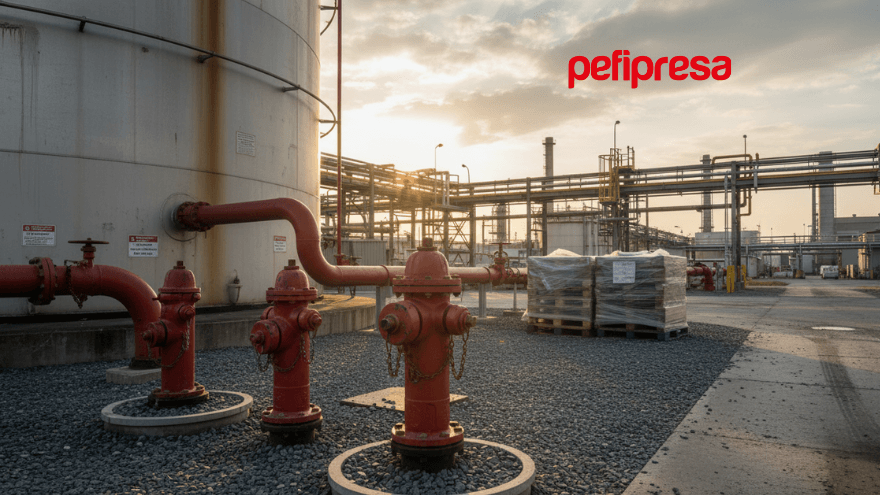
External hydrants are the only ones regulated by Spanish regulations. Their location is defined by RSCIEI, which establishes maximum distances, accessibility requirements for fire vehicles, and spatial coverage criteria. The outlet configuration according to RIPCI defines the number and diameter of outlets, typically with configurations of 2 outlets of 70mm or 45mm depending on hydrant type.
Fire department connection
In Spain, siamese connections or dry standpipe supplies are commonly used, allowing firefighters to inject additional water into the system from their own vehicles. These connections must be located in accessible locations and properly marked, facilitating rapid response in emergencies.
It’s important to note that the term FDC (Fire Department Connection) is not common in Spanish regulatory terminology, although the concept is equivalent to the siamese connections regulated in our country.
Internal hydrants
They can be used as reinforcement in very large interior spaces, especially in logistics or high-bay industrial warehouses. However, it should be noted that internal hydrants are not specifically defined in Spanish regulations as a differentiated category, so their installation must be adequately justified in the project and coordinated with other active systems such as hose reels or sprinklers.
Corrosion protection
Piping in a hydrant network can be protected against corrosion through different techniques. Interior and exterior epoxy coatings offer excellent chemical protection. Coated ductile iron combines mechanical resistance with durability. Hot-dip galvanizing provides effective cathodic protection especially for steel pipes.
Selection of the protection method must consider specific environmental conditions (humidity, salinity, soil pH) and chemical aggressiveness of the supply water, aspects that at PEFIPRESA we evaluate through specific analyses for each project.
Pressure groups and supply criteria
Supply according to UNE 23500
This fundamental standard allows multiple water supply configurations, which include pressure tanks, gravity elevated tanks, connection to public networks, and pumping groups drawing from gravity tanks or inexhaustible sources. The specific design depends on the required reliability level, expressed as supply category.
Higher categories require equipment redundancy, duplicate electrical supplies, and automatic switching systems that guarantee continuous system availability even in the face of multiple failures. In critical installations, PEFIPRESA implements configurations with redundant main pumps and auxiliary systems that maximize operational reliability.
Pump flow and characteristics
European standards establish that fire pumps must guarantee a flow rate higher than nominal at the required verification point, ensuring performance reserve. This reserve compensates for natural equipment aging and possible variations in operating conditions.
Pump room
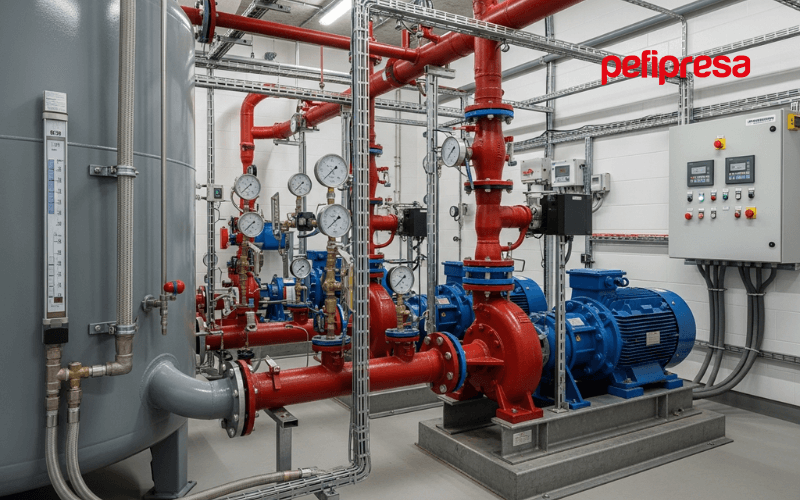
The pump room must be an independent space from other services and have adequate thermal conditions, maintaining temperatures between 5 and 40°C to guarantee correct equipment operation and startup reliability in any season. Ventilation must be sufficient to dissipate heat generated by motors and prevent moisture accumulation.
The room’s fire resistance must meet requirements established by its location according to CTE or RSCIEI. Access must allow equipment maintenance, with sufficient space for extraction of pumps and motors. At PEFIPRESA, we design pump rooms considering not only regulatory requirements but also long-term operational maintenance needs.
Suction and discharge conditions
Both UNE 23500 and UNE EN 12845 standards establish very specific conditions for suction and discharge piping. Suction must be designed minimizing head losses, avoiding air pockets, and guaranteeing sufficient net positive suction head (NPSH) to prevent cavitation.
Discharge must include check valves to prevent backflow, sectioning valves for maintenance, and pressure gauges for pressure verification. Direction changes must be made with long radius elbows and reductions using eccentric pieces that prevent air accumulation.
PEFIPRESA designs and certifies each pumping group according to these specific technical criteria, ensuring maximum reliability and durability of pumping equipment.
Testing and maintenance
RIPCI establishes mandatory maintenance operations that must be performed periodically on hydrant networks. These operations include quarterly pressure and system operation tests, verifying absence of leaks and correct condition of valves and accessories.
Semi-annual pump tests include automatic startup, verification of pressures and flow rates at different points on the curve, and checking of auxiliary systems such as jockey pumps and emergency electrical supply.
The annual test with actual hydrant opening and flow and pressure verification is the most complete and demanding test, validating correct system operation under conditions close to actual emergency use.
At PEFIPRESA, we accompany our clients throughout the installation’s useful life through certified maintenance services that guarantee regulatory compliance, documentation of all operations according to UNE 23580, and early detection of any anomaly that could compromise system operability.
Conclusion
The design of hydrant networks requires a complex balance between accumulated technical experience, rigorous compliance with applicable regulations, and deep understanding of the specific risk of each installation. At PEFIPRESA, our team of fire protection specialized engineers guarantees reliable systems perfectly adapted to each project, backed by more than six decades of experience and access to advanced hydraulic calculation and measurement technologies.
A correctly designed, installed, and maintained hydrant network saves lives, protects critical assets, and ensures business continuity. This is our specialty and the commitment we maintain with each client who trusts our experience.
If your facility requires the design of a new hydrant network or the evaluation and updating of an existing one, our technical team is at your disposal to develop an optimal technical solution that meets all regulatory requirements and adapts to the specific needs of your activity.